Commercial Pressure Washing Cost in South Florida: 2026 Pricing Guide for Property Managers
Commercial pressure washing pricing in South Florida is shaped by two things: the property and the contract. This guide breaks down real 2026 ranges by property type, the Florida statutes that affect how HOAs and condo associations must handle bids, and what actually drives a commercial quote up or down.
Not legal advice; pricing is illustrative. Dollar ranges below are typical 2026 South Florida market observations from our own commercial book. Specific quotes vary widely based on scope, access, height, and recurring vs one-time work. Florida statutes cited are summarized from the official text on leg.state.fl.us. Consult your association attorney for any binding decision.
Quick Navigation
The 30-Second Summary
Most commercial pressure washing in South Florida prices in the $0.10 to $0.50 per square foot range, with the cost shifting based on five variables: square footage, surface type, building height, access constraints, and whether the contract is recurring or one-time.
Typical 2026 South Florida Ranges
- • HOA / condo common-area annual wash (10,000 to 50,000 sq ft total): $2,500 to $12,500
- • Small office or strip retail facade + walkways (5,000 to 15,000 sq ft): $1,200 to $4,500
- • Mid-size office complex with parking deck (50,000 to 150,000 sq ft): $8,500 to $32,000
- • Industrial warehouse exterior (any size): $0.08 to $0.18 per sq ft
- • Boom-lift facade work (4+ stories): add 25 to 60 percent to base square-foot rate
- • After-hours / overnight scheduling: add 15 to 30 percent
- • Recurring annual contract (vs one-time): typically reduces per-visit rate 10 to 20 percent
For HOAs and condominium associations specifically, Florida Statute 720.3055 controls whether the board must obtain competitive bids before signing. The threshold is contracts exceeding 10 percent of the total annual budget including reserves. For a typical mid-size South Florida community, this means anything above roughly $20,000 to $40,000 triggers the bidding requirement. See our companion Florida HOA pressure washing requirements guide for the full statutory framework.
How Commercial Pricing Actually Works
Commercial pressure washing quotes look nothing like the flat rates you see on residential price lists. The cost structure is built from several different unit prices stacked together.
Per Square Foot
Most flat surfaces (walkways, plazas, parking decks, walls, roofs) bill per square foot. South Florida 2026 commercial rates typically run $0.10 to $0.50 per square foot depending on surface and complexity. Concrete sidewalks at the low end. Soft-wash facade work at the high end. Roof soft washing on commercial buildings sits in the middle at roughly $0.20 to $0.35 per square foot.
Per Linear Foot
Certain features bill by linear measurement: curbs, fencing, awnings, pool deck coping. These often run $1 to $4 per linear foot depending on material and access.
Per Visit Minimum
Most commercial contractors set a per-visit minimum (commonly $250 to $500 in South Florida) regardless of how small the job is. This covers crew mobilization, water, fuel, and the basic cost of getting a truck on-site. Very small spot-cleaning jobs at large properties often hit this minimum even when the square footage would calculate to less.
Recurring vs One-Time Discount
Annual or semi-annual contracts almost always price lower per visit than one-time bookings. Contractors discount recurring work because mobilization costs spread across more visits and route-density efficiencies kick in. Expect 10 to 20 percent off comparable one-time pricing for a true recurring contract.
Cost Ranges by Property Type
Different commercial property types carry different cost profiles because of the surfaces involved, the access constraints, and the typical scope.
HOA and Condominium Associations
A typical South Florida HOA wash includes community entrance signage and gates, clubhouse exteriors, pool deck, fence lines, sidewalks, and mailbox kiosks. For a community with 10,000 to 50,000 square feet of cleanable common area, expect annual contracts in the $2,500 to $12,500 range. Add building exteriors if the association is a condominium under Chapter 718 and responsible for the structure itself, which can push annual contracts to $25,000 or more for mid-rise buildings. Our Miami commercial pressure washing teams handle both detached-home HOAs and condominium associations.
Office Complexes
Class A office buildings typically need quarterly exterior maintenance: entry plazas, walkways, parking deck, and tenant-facing facade surfaces. For a 50,000 to 150,000 square foot office complex, expect $8,500 to $32,000 in annual contract value. Higher if the building is over four stories and requires boom lifts. Lower for single-story garden-office complexes with simple ground-level access.
Retail and Strip Centers
Retail properties focus pressure washing on tenant storefronts, sidewalks under the awning line, parking lot striping cleanup, and trash enclosures. Quarterly is standard. A 10-tenant strip center typically books between $4,000 and $14,000 annually depending on parking lot size and whether the contract includes monthly storefront sidewalk rinses.
Industrial and Warehouse
Industrial pricing usually quotes flat at $0.08 to $0.18 per square foot for exterior wall cleaning, with the cost driven heavily by access (loading docks, fenced compounds) and by whether the work has to happen during off-shift hours to avoid forklift traffic. Most industrial facilities only need exterior pressure washing annually unless they handle food processing or have aesthetics-sensitive corporate office attached.
Multi-Family Apartments
Multi-family pricing sits between HOA and pure commercial. Annual contracts for a 100-unit garden-apartment community typically run $6,000 to $18,000, covering breezeways, stair towers, pool deck, dumpster pads, and amenity areas. High-rise multi-family pricing climbs steeply with boom lift requirements.
Need a Real Quote for Your Property?
Send a site survey or just a property address and we will provide an itemized commercial bid that breaks down per-surface pricing, insurance documentation, and stormwater protocol. Serving HOA, condo, and commercial properties across Miami-Dade, Broward, and Palm Beach.
What Drives Cost Up
Five variables push commercial pressure washing pricing higher. Knowing which apply to your property explains a lot of the spread between quotes.
Height and Boom Lift Requirements
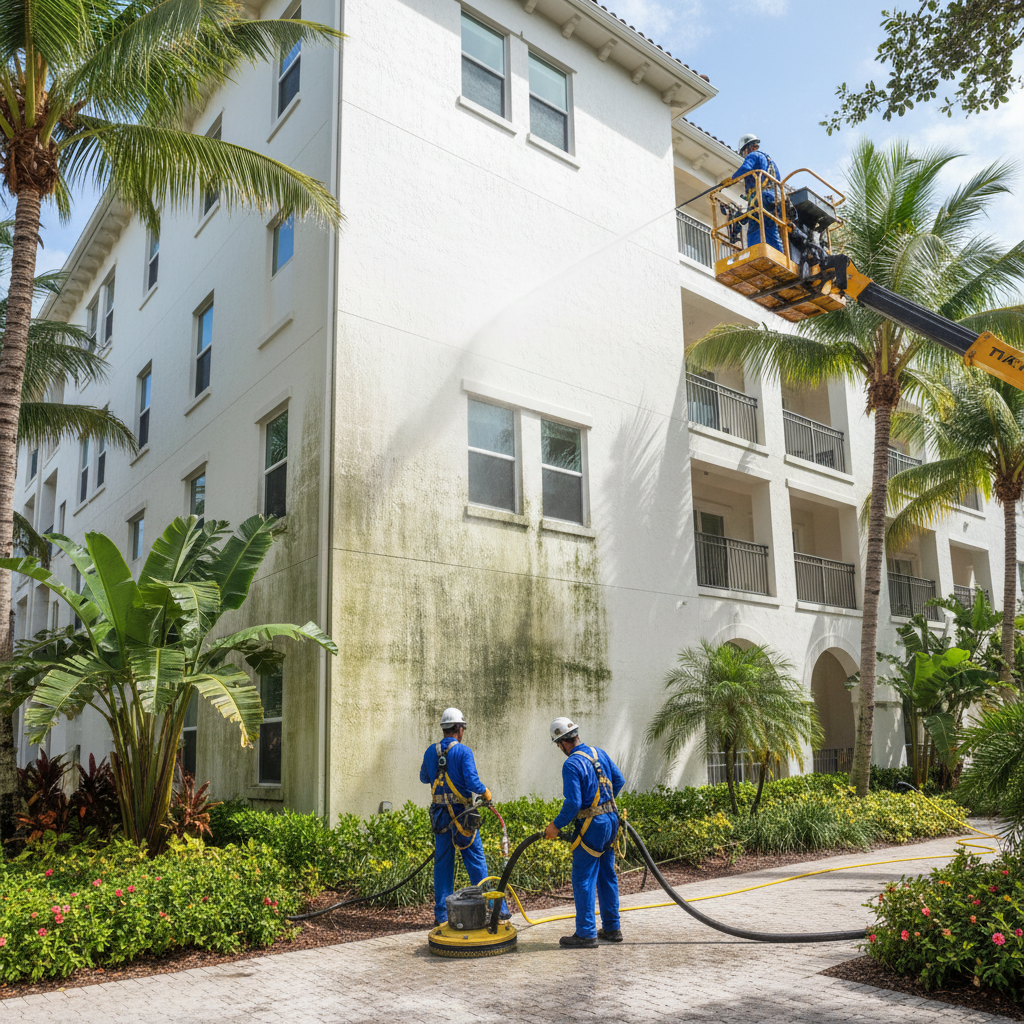
Any building over two stories typically requires a boom lift or scissor lift for facade work. Boom lift rental in South Florida runs $300 to $700 per day plus delivery and pickup fees. That cost transfers to the quote either as a direct line item or rolled into a higher per-square-foot rate. Expect a 25 to 60 percent premium over single-story rates.
After-Hours and Weekend Scheduling
Office buildings, retail, and any property with significant daytime foot traffic often require pressure washing during off-hours. Overnight and weekend crew premiums typically add 15 to 30 percent. Some properties require Sunday-only access because of weekday operations and Saturday HOA quiet-hours rules, which compresses crew availability and pushes the premium higher.
Stormwater Capture Requirements
Properties near storm drains, those with strict environmental compliance programs, and any commercial site adjacent to surface water often require vacuum recovery of wash water. Closed-loop water capture equipment adds capital cost that contractors recover through their pricing. Expect 10 to 20 percent above baseline for full-capture protocols. The Florida Department of Environmental Protection administers the federal NPDES stormwater permitting program in Florida under Section 403.0885 of the Florida Statutes, and the underlying federal Clean Water Act Section 402 makes uncaptured chemical-laden runoff a potential violation for both the contractor and the property owner.
Access Constraints
Gated communities, properties with no exterior water hookup, narrow alleyways, parking deck access limitations, and any site requiring loading dock coordination add labor time. Expect 10 to 25 percent added for difficult-access properties. Sites that require a portable water tank because there is no usable hose bib see the largest premium.
Specialty Surface Materials
Travertine, coral stone, polished concrete, terrazzo, and other delicate surfaces require lower pressure and pH-neutral chemistry. The slower work and specialty materials push pricing 30 to 50 percent above standard concrete or stucco rates. Properties with mixed surface materials should expect the quote to break out specialty zones separately.
What Drives Cost Down
Three patterns consistently reduce commercial pressure washing cost without cutting scope or quality.
Multi-Year Recurring Contracts
A two or three-year contract gives contractors route stability and lets them spread mobilization costs over more visits. Most South Florida commercial pressure washing vendors will discount 10 to 20 percent on multi-year agreements compared to year-by-year renewals. Ask about the multi-year rate explicitly when soliciting bids.
Service Bundling
Bundling roof cleaning, paver sealing, and exterior wall washing in a single visit reduces per-service pricing because the crew is already on-site with equipment deployed. A bundled annual maintenance contract typically saves 10 to 15 percent versus booking each service as a separate visit. Combined service packages that include concrete wash and seal services and commercial roof cleaning are the most common bundles.
Off-Peak Scheduling
South Florida pressure washing demand peaks in April and May before hurricane season, then again in October and November after storms pass. Booking work in the slower middle-summer or mid-winter months can reduce pricing 5 to 10 percent on a per-job basis. The trade-off is potential weather interruption during the rainy season, which means recurring contracts tend to capture this discount more reliably than one-time jobs.
The Florida HOA Bid Rule
For HOAs and condominium associations, the question of how much you pay for pressure washing is partly controlled by Florida statute, not just market pricing.
The 10 Percent Threshold
Florida Statute 720.3055 requires HOAs to obtain competitive bids when a contract for materials, equipment, or services exceeds 10 percent of the association's total annual budget including reserves. For a typical mid-size South Florida community with a $250,000 total annual budget, the bid threshold is $25,000. A pressure washing contract at $18,000 does not trigger statutory bidding. A contract at $32,000 does.
Quick Threshold Reference
- • $100,000 budget: bid required above $10,000
- • $250,000 budget: bid required above $25,000
- • $500,000 budget: bid required above $50,000
- • $1,000,000 budget: bid required above $100,000
- • $5,000,000 budget: bid required above $500,000
Section 720.3055 does not specify a minimum number of bids when the threshold is triggered. Florida community association law firms commonly recommend at least two and ideally three competitive bids. The statute also explicitly preserves the board's discretion to choose any qualifying bid, not just the lowest one.
Exemptions From the Bid Rule
Section 720.3055 specifies several exemptions including contracts with attorneys, accountants, community association managers, architects, engineers, and landscape architects; contracts executed before October 1, 2004 and their renewals; sole-source vendors within the county; and emergency purchases (typically immediate post-hurricane cleanup). Pressure washing is not on the exempt list, so the 10 percent threshold applies in the normal course.
HB 1203 Records Posting
As of January 1, 2025, HOAs with 100 or more parcels must post current executory contracts and a list of bids received within the past year on a community website or mobile-accessible application. This is part of HB 1203, which became effective July 1, 2024 and added significant transparency requirements to Florida HOA operations. Pressure washing contracts above the bid threshold belong on the website along with the bid documentation.
How to Compare Quotes
Apples-to-apples bid comparison is the single biggest determinant of whether a property manager gets fair pricing. The following checklist normalizes commercial pressure washing bids so the dollar amounts actually mean the same thing.
Bid Comparison Checklist
- • Itemized scope. Each surface listed separately with square footage and chemistry type (soft wash, surface clean, hot water).
- • Pressure and chemistry specifications. Specific PSI ranges and chemical solutions for delicate surfaces (coral stone, travertine, painted stucco).
- • Stormwater handling protocol spelled out in writing per the prior section.
- • Insurance documentation attached as exhibit: commercial general liability policy with association or property named as additional insured, current certificate; Florida workers compensation per Chapter 440 or a state-issued exemption certificate.
- • Indemnification clause naming the property owner.
- • Damage protocol covering landscaping, light fixtures, paint blowoff, and window seal damage.
- • Resident or tenant notice procedure spelled out (lead time, channel).
- • Access hours permitted (after-hours, weekends).
- • Recurring vs one-time rate with the recurring rate explicitly broken out for comparison.
- • Termination clause with reasonable notice on both sides.
Bids that arrive as a single dollar amount without itemization are not actually comparable. The cheapest top-line number frequently turns out to be the most expensive once change orders, missing scope items, and damage repair bills accumulate. The post on commercial vs residential pressure washing differences covers the operational scope distinctions that commercial bids should reflect.
Property Manager Red Flags
Certain bid patterns reliably signal trouble. Each of these is worth treating as a disqualifying factor unless the vendor can explain it away convincingly.
- Top-line number with no itemization. Cannot be apples-to-apples compared, and frequently hides scope gaps.
- No certificate of insurance attached or the COI lists a different entity than the contracting company. The named insured on the COI should exactly match the company you are signing with.
- No workers compensation coverage or exemption certificate. Florida Statute Chapter 440 requires it for construction businesses with one employee and non-construction businesses with four. The contracting property can carry premises-liability exposure if a worker is injured on-site without coverage.
- Same flat rate for travertine, coral stone, and standard concrete. Means the vendor will use the same equipment and pressure on every surface. Specialty surfaces will get damaged.
- Promises to pressure wash an asphalt shingle roof. Both the Asphalt Roofing Manufacturers Association and GAF explicitly prohibit power washing of shingles. A vendor offering it does not know the trade. See our companion piece on black streaks on South Florida roofs for the authoritative position.
- Vague answer about wash water handling. Compliance risk transfers to the property owner.
- Offers to clean and seal pavers in the same visit. Sealing requires 48 to 72 hours of dry shingle surface to cure properly. Same-visit cleaning plus sealing is a corner-cutter that you will see in the finish.
- Significant kickback or gift offers to board members or property managers. Under HB 1203, knowingly accepting a kickback is now a third-degree felony for HOA officers, directors, and managers in Florida.
- Quote arrives without a signed proposal or contract template. Verbal agreements on commercial pressure washing scopes consistently end in disputes.
The Real ROI Math
Commercial pressure washing is one of the highest-ROI exterior maintenance line items on a commercial property budget. The math is straightforward once you tie the cost of cleaning against the cost of deferred maintenance.
Paver and Concrete Surfaces
A typical 50,000 square foot paver walkway and pool deck system costs $1.50 to $4.50 per square foot to repair or restore once mature algae colonies have penetrated the joint sand and caused the polymeric binder to break down. That is $75,000 to $225,000 in repair cost. The same system kept on a 12 to 18 month cleaning cycle at $0.20 to $0.35 per square foot per visit costs $10,000 to $17,500 annually and prevents the deeper damage. Two annual cleanings cover the cost of full replacement in roughly four to eight years if deferred.
Stucco and Painted Building Exteriors
Salt-driven biological staining accelerates paint failure on stucco facades, especially within a mile of the Atlantic or Biscayne Bay. Repainting a four-story 50,000 square foot stucco building runs roughly $4 to $8 per square foot prep and paint, or $200,000 to $400,000. A maintenance soft wash cycle every 18 to 24 months at $0.30 to $0.45 per square foot is $15,000 to $22,500 per cycle and routinely extends paint life by 50 to 100 percent. The cleaning cost is less than 10 percent of the paint job it defers.
Roof Soft Washing
For asphalt shingle roofs, the ARMA position is that algae staining does not actually damage the shingles structurally. The ROI case for commercial roof soft washing is therefore aesthetic and reflective performance, not premature failure prevention. For tile and metal commercial roofs, however, biological growth does create real maintenance issues, and regular soft washing materially extends life. See our South Florida commercial roof cleaning service for specifics by roof type.
Curb Appeal and Tenant Retention
For Class A office, retail, and Class A multi-family, exterior appearance is a direct input into tenant retention and lease renewal rates. Commercial real estate research consistently shows that exterior condition correlates with vacancy rate and rent premium. Pressure washing is the lowest-cost exterior intervention a property manager can deploy to maintain Class A appearance. The contracted cost of a maintenance program is typically less than one month of vacancy on a single unit at most South Florida properties.
Frequently Asked Questions
How much does commercial pressure washing cost in South Florida?
Most commercial pressure washing in South Florida prices in the $0.10 to $0.50 per square foot range. Typical 2026 contract values: HOA or condo common-area annual wash for 10,000 to 50,000 square feet runs $2,500 to $12,500. Mid-size office complex (50,000 to 150,000 sq ft) runs $8,500 to $32,000 annually. Industrial warehouse exterior runs $0.08 to $0.18 per square foot. Boom lift work above two stories adds 25 to 60 percent. After-hours scheduling adds 15 to 30 percent. Multi-year recurring contracts typically discount 10 to 20 percent versus one-time bookings.
What should be included in a typical commercial pressure washing bid?
A bid-ready proposal lists each surface separately with square footage, specifies pressure (PSI) and chemistry for delicate surfaces, spells out the stormwater capture protocol in writing, attaches a current certificate of insurance with the property named as additional insured, includes documentation of Florida workers compensation coverage per Chapter 440 (or a state-issued exemption certificate), includes an indemnification clause naming the property owner, defines the damage protocol, specifies access hours and resident-notice procedure, and breaks out recurring vs one-time pricing for comparison.
When does a Florida HOA need to obtain competitive bids?
Florida Statute 720.3055 requires competitive bids when a contract exceeds 10 percent of the association's total annual budget including reserves. For a $250,000-budget HOA the threshold is $25,000. The statute does not specify a minimum number of bids, but Florida community association attorneys recommend at least two and ideally three. The board may consider experience, references, scope, and insurance limits when selecting; it is not required to accept the lowest bid. HB 1203 (effective July 1, 2024) added that HOAs with 100 or more parcels must post current executory contracts and bids received in the past year on a community website or app by January 1, 2025.
Should we sign a recurring contract or bid each job separately?
For predictable annual or quarterly work like HOA common-area maintenance, office complex exterior cycles, and retail center programs, recurring contracts almost always price lower per visit (typically 10 to 20 percent less than one-time bookings) and reduce administrative overhead at both ends. For one-off projects like post-construction cleanup or post-storm recovery, bidding each job separately makes sense because scope varies materially. Many properties run a recurring contract for predictable work and bid additional one-off services as they arise. Multi-year recurring contracts (two or three years) often capture an additional 5 to 10 percent discount.
Why is commercial pressure washing more expensive than residential?
Commercial work carries cost layers that residential does not: higher insurance limits required by commercial properties (commercial general liability often $2 million or more aggregate), Florida workers compensation coverage required when crew size grows beyond residential-handyman scale, boom lift and specialized equipment for multi-story buildings, after-hours and weekend scheduling premiums to avoid disrupting tenants or operations, stormwater capture equipment for compliance, and indemnification and contract-administration overhead. The per-square-foot rate often looks similar to residential on paper, but the total contract value reflects these added requirements.
How can we lower commercial pressure washing cost without cutting corners?
Three patterns consistently reduce cost: sign multi-year recurring contracts (10 to 20 percent discount on per-visit pricing because contractors get route stability), bundle multiple services into a single visit (10 to 15 percent savings when the same crew handles roof soft wash, paver cleaning, and facade work in one mobilization), and schedule during off-peak months (5 to 10 percent reduction). What does not lower cost meaningfully: choosing the lowest bidder. The cheapest top-line number frequently has missing scope items, no stormwater capture, inadequate insurance, or use of pressure on surfaces that should be soft-washed, which generates damage cost that exceeds the original savings.
Statutes and Sources Referenced
- • Florida Statute § 720.3055 - HOA competitive bidding requirements (10 percent of annual budget threshold including reserves), statutory exemption list, board discretion to choose among qualifying bids
- • Florida Statute Chapter 720 - Homeowners' Association Act (2025 edition)
- • Florida House Bill 1203 (2024), effective July 1, 2024, Chapter 2024-221, L.O.F. - Records-posting requirements for HOAs with 100 or more parcels effective January 1, 2025, kickback felony for HOA officers and managers
- • Florida Statute Chapter 440 and § 440.02(20)(b) - Workers compensation employment thresholds: 1+ employee for construction industry, 4+ employees for non-construction businesses
- • Federal Clean Water Act § 402 and the NPDES stormwater permitting program
- • Florida Statute § 403.0885 - Florida DEP authority to administer NPDES stormwater program in Florida (authorized by EPA in October 2000)
- • EPA National Menu of Best Management Practices for Stormwater - Classification of detergent-bearing pressure washing runoff as illicit discharge
- • Asphalt Roofing Manufacturers Association (ARMA) Technical Bulletins on algae discoloration of roofs - position against power washing of asphalt shingle roofs
- • Dollar ranges throughout this guide are illustrative 2026 South Florida operational market observations and not claims of researched industry-wide averages. Specific contract pricing varies based on scope, access, square footage, and recurring vs one-time structure.
This guide is for general orientation only. Statutes change, governing documents vary, and commercial pricing is property-specific. Run any binding decision past your association attorney, property management firm, or licensed contractor before acting on it.
Related Articles
HOA Pressure Washing Requirements in Florida: A Board Member's Guide
The full statutory framework: § 720.305 enforcement, § 720.3035 architectural authority, vendor checklist.
Commercial vs Residential Pressure Washing Differences
The operational scope distinctions that commercial bids should reflect.