How Much Does It Cost to Remove Algae from Pavers in South Florida
Algae paver cleaning in South Florida runs $175 to $650 average. See real prices by paver type, what affects quotes, and how to keep it from coming back.
Quick Navigation
The green and black streaks creeping across your paver driveway are not just dirt. They are a living organism feeding on the limestone in your pavers, and the longer you leave them, the more porous and damaged the surface gets. Every South Florida homeowner ends up dealing with it at some point.
The good news: removing algae from pavers is one of the cheapest exterior services you can book. The bad news: prices vary wildly because most companies quote based on what the surface looks like, not standard rates. A 600 square foot driveway in Coral Gables and the same size driveway in Pompano Beach can get quotes $300 apart for the exact same work.
This guide gives you the real cost ranges, what actually drives the price up or down, and how to tell whether a quote is fair before you book it.
The Real Cost: Quick Answer
Professional algae removal from pavers in South Florida costs $175 to $650 for most residential driveways. The price reflects square footage, paver type, and how deep the algae growth has set in. Lightly stained driveways under 400 square feet typically fall on the low end. Heavily colonized paver patios over 1,000 square feet land near the top.
Quick Price Reference
- • Small paver walkway (under 200 sq ft): $125 to $225
- • Standard paver driveway (400 to 600 sq ft): $200 to $375
- • Large driveway plus walkway (800 to 1,200 sq ft): $350 to $550
- • Full property package (driveway, pool deck, patio): $475 to $850
- • Add re-sand joints: $0.15 to $0.35 per square foot
- • Add full seal after cleaning: $1.25 to $2.50 per square foot
Most established companies bill per square foot for the cleaning portion. Expect to pay $0.30 to $0.65 per square foot for paver algae removal alone. Adding crack-joint sand replacement and a protective sealer typically doubles the total but extends the result from one season to three or four years.
Why South Florida Pavers Are an Algae Magnet
The green and dark streaks running across paver surfaces are usually a mix of two organisms. Most of the green coloring comes from chlorophyta, a basic plant algae. The darker streaking is often Gloeocapsa magma, a cyanobacteria that feeds on the calcium carbonate in concrete pavers, limestone aggregate, and crushed-coral fill.
South Florida sits in nearly perfect breeding conditions for both. Average humidity stays above 70 percent year-round. Afternoon rainstorms keep paver surfaces damp for hours at a time. Tropical shade from royal poinciana, banyan, and oak canopies blocks the UV that would otherwise sterilize the surface. Irrigation overspray adds even more moisture.
The coastal zone makes it worse. Salt-laden air from Biscayne Bay and the Atlantic settles on pavers and absorbs ambient moisture, keeping the surface wet even on dry days. Properties within a mile of the water see roughly 40 percent faster algae return than inland homes in places like Weston or Plantation.
Why It Spreads So Fast on Pavers Specifically
Concrete and brick pavers are porous by design. Microscopic pores hold water, and that water never fully dries between rain cycles. Once a colony establishes in those pores, it spreads through the entire driveway within 12 to 18 months. The polymeric sand between paver joints also holds organic debris that algae feed on.
The same biological growth that makes north-facing walls go dark is what creeps across your paver driveway cleaning surfaces from the shaded edges inward. Drivers usually notice it first along the property-line side, then near the garage door overhang.
Cost Breakdown by Paver Type
Not every paver cleans the same way, and the labor and chemical differences show up in the quote.
Concrete Pavers
The most common paver in South Florida residential driveways. Concrete pavers from manufacturers like Belgard, Oldcastle, and Tremron handle a soft-wash cleaning solution well. Pricing runs $0.30 to $0.50 per square foot. A typical 600 square foot driveway falls in the $180 to $300 range.
Brick Pavers
Clay brick pavers found in older Coral Gables, Coconut Grove, and Old Cutler Road properties hold dye longer than concrete but are slightly more porous. Pricing sits at $0.35 to $0.55 per square foot. The same 600 square foot driveway runs $210 to $330.
Travertine Pavers
Popular on pool decks and patios in newer construction across Doral, Aventura, and Boca Raton. Travertine is softer than concrete and pits easily under high pressure, so soft-wash technique is mandatory. Pricing runs $0.45 to $0.75 per square foot because of the extra care required. A 600 square foot pool deck typically costs $270 to $450.
Coral Stone and Keystone
Common in waterfront properties in Coconut Grove, Key Biscayne, and Palm Beach Island. Coral stone is the most porous and most delicate of the common paver materials. It cannot tolerate pressure above 500 PSI without surface damage. Pricing is $0.55 to $0.90 per square foot because the work is slow and the chemicals must be pH-neutral. A 600 square foot driveway runs $330 to $540.
Important
If a contractor quotes the same per-square-foot rate for travertine or coral stone as they do for concrete, ask what pressure they plan to use. The wrong technique on a soft paver causes pitting that no amount of sealing will hide.
What Drives the Price of a Quote
Two driveways with identical square footage can get quotes $200 apart. These are the variables that move the number.
Severity of Growth
Algae that has been on the surface for two years takes longer to remove than algae from last rainy season. Heavy colonies need a longer chemical dwell time, two or three passes, and often a second visit a week later if it has reached the joint sand. Expect a 25 to 40 percent surcharge on heavily stained surfaces.
Access and Water Source
Gated communities, narrow side yards, or properties with no exterior hose bib add to the cost. If the crew has to run lines through the garage or set up a portable water tank, the job takes longer. Properties in waterfront gated areas can see 10 to 15 percent added for access.
Joint Sand Condition
Cleaning blows the polymeric sand out of paver joints. If the existing sand is already 70 percent gone, the crew needs to re-sand the entire driveway to lock the pavers back in place. Re-sanding adds $0.15 to $0.35 per square foot and takes an extra hour or two.
Adding Sealing to the Job
Sealing after cleaning is the single biggest upsell in this industry, and the math actually works in your favor. A $300 cleaning that has to be repeated every 9 months costs $400 a year. A $300 cleaning followed by a $700 sealer that lasts three years costs $333 a year and the driveway looks dramatically better the entire time. Read more on this in our complete guide to driveway sealing in South Florida.
Want a Real Quote Instead of a Range?
Send a few photos of your driveway or patio and we will give you a fixed-price quote in under an hour. No on-site visit required for most properties. Serving all of Miami-Dade, Broward, and Palm Beach.
DIY vs Professional: When Each Makes Sense
Algae removal is one of the few exterior services where DIY can work if the conditions are right. It can also destroy a $15,000 paver installation if they are wrong.
When DIY Is Reasonable
Walkways under 200 square feet, shallow surface staining only, concrete pavers (never travertine or coral stone), and a willingness to spend a weekend on it. A consumer-grade pressure washer at 1,800 PSI with a 25-degree fan tip and a gallon of sodium-hypochlorite-based cleaner runs about $80 to $150 in supplies. Plan on three to four hours of work.
When You Want a Professional
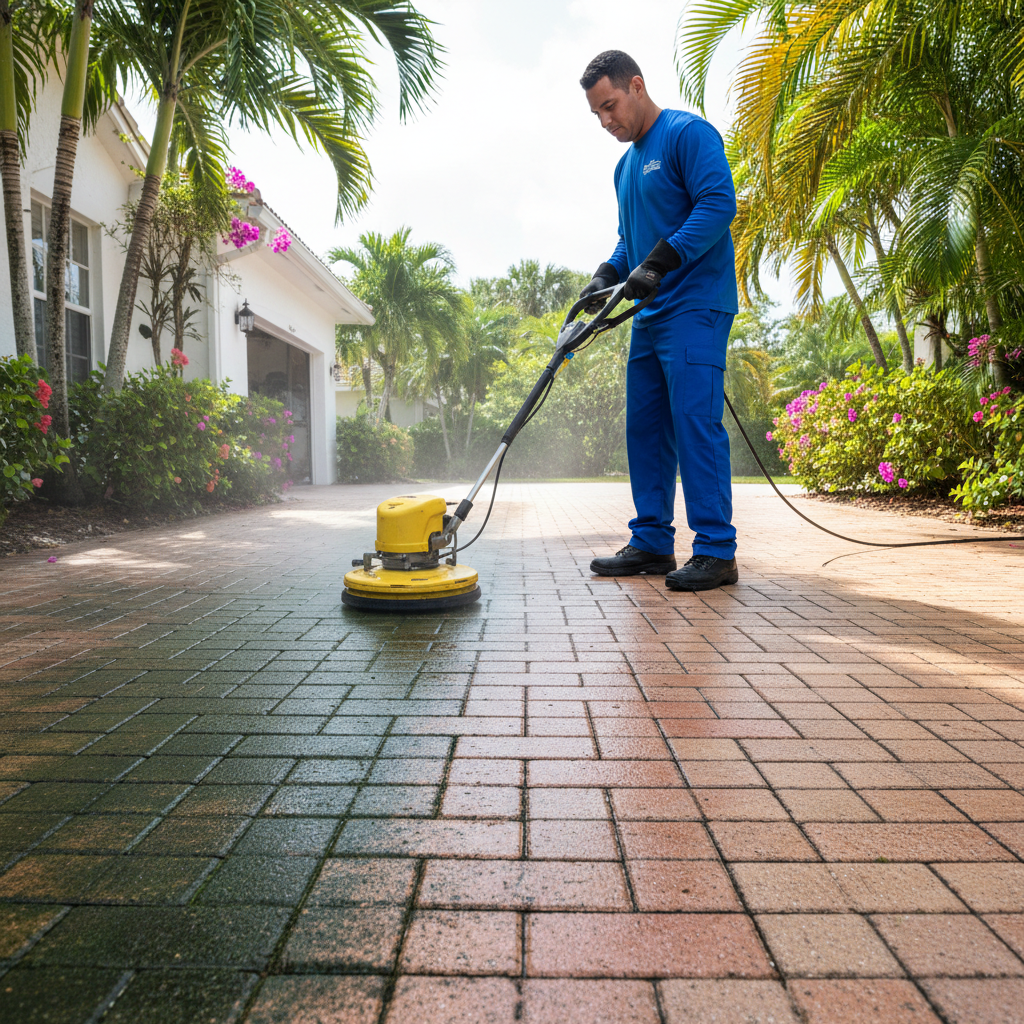
Driveways over 400 square feet, mature algae colonies that have set into joint sand, any paver type other than standard concrete, properties where a damaged driveway would cost more than a year of cleanings to replace, or homeowners who do not want to spend a Saturday handling chemicals. Professional crews use 3,500 to 4,000 PSI commercial equipment with rotating surface cleaners that finish the same job in 90 minutes.
The Damage Risk Most People Miss
Direct high-pressure nozzles held too close to a paver surface erode the top millimeter of material in seconds. On concrete pavers this exposes the rough aggregate underneath, which then attracts dirt and algae faster than the original surface. On travertine and coral stone the damage is permanent. Most DIY paver damage in South Florida comes from a homeowner with a Karcher and good intentions, not from professional equipment.
What You're Actually Paying For
A reputable algae removal job is not just a pressure washer and a bottle of bleach. The process matters more than the chemicals.
Standard Process (60 to 120 minutes for a typical driveway)
- • Pre-treatment with sodium hypochlorite plus surfactant, 8 to 12 minute dwell
- • Soft-wash rinse at 100 to 500 PSI for delicate pavers, or surface-clean pass at 3,000 PSI for concrete
- • Edge detail work with a fan-tip wand to reach corners and curbs
- • Joint inspection and polymeric sand replacement where needed
- • Final rinse and inspection walk-through
- • Optional sealing on a separate visit once pavers fully dry, typically 48 hours later
The two-visit pattern is intentional. Sealing pavers that have not fully dried traps moisture under the sealer and causes a white-haze effect that can require a complete strip and reseal to fix. A contractor who offers to clean and seal in the same visit is cutting a corner that you will see in the finish.
If you want full-property treatment beyond the driveway, ask about combined pricing for paver wash and seal services alongside exterior house soft washing. Most companies discount 10 to 15 percent when crews are on-site for multiple services.
How Long the Cleaning Lasts
A standard cleaning without sealing keeps pavers looking restored for 8 to 14 months in South Florida. Coastal properties trend toward the lower end. Inland or sun-exposed driveways trend higher. Adding a quality paver sealer extends the visible result to 3 to 4 years before re-cleaning is needed.
What Speeds Up the Algae Return
Heavy tree canopy that blocks afternoon sun, irrigation systems that hit the driveway during the rainy season, and any standing water from poor drainage all dramatically shorten the result. Properties with a north-facing driveway under oak shade can see fresh algae within 6 months.
Maintenance Schedule That Actually Works
The most efficient approach is a deep clean every 18 to 24 months combined with a light maintenance rinse every spring before the rainy season starts. Timing the work right matters more than most people think, and the best times to pressure wash a South Florida property shift across the year based on humidity and storm patterns.
Average Prices Across South Florida Cities
Pricing varies modestly by city based on labor cost, average property size, and how often crews work in that area. These are typical 2026 numbers for a 600 square foot paver driveway with standard concrete pavers and moderate algae growth.
| City | Typical Price Range | Notes |
|---|---|---|
| Miami | $200 to $345 | Coastal humidity drives faster regrowth |
| Coral Gables | $225 to $385 | Many older brick paver driveways under tree canopy |
| Fort Lauderdale | $210 to $360 | Waterfront properties add 10 to 15 percent |
| Boca Raton | $235 to $400 | Larger average driveway size pushes totals up |
| West Palm Beach | $215 to $370 | Travel surcharge applies to some gated communities |
| Doral | $200 to $345 | Newer construction means more travertine and pavers |
| Weston | $195 to $335 | Inland location slows regrowth, lower base rate |
Properties in waterfront gated communities or on private islands typically add a small access surcharge. Bundled jobs that include patio, pool deck, and driveway cleaning in a single visit usually drop the per-square-foot rate by 10 to 15 percent across the board.
Frequently Asked Questions
How much does algae removal from pavers cost in Miami?
A standard 600 square foot paver driveway in Miami runs $200 to $345 for professional algae removal in 2026. Smaller walkways under 200 square feet typically fall between $125 and $225. Larger driveways or full-property bundles that include patio and pool deck cleaning land between $475 and $850. Coastal properties in Brickell, Coconut Grove, and Key Biscayne tend toward the upper end of the range because of higher humidity and faster algae return. Adding paver sealing after the cleaning typically doubles the total but extends the visible result from one season to three or four years. Always get a quote based on actual square footage rather than a flat fee.
Will pressure washing damage my pavers?
High pressure can damage pavers when the wrong technique is used. Concrete pavers handle 3,000 PSI surface cleaners safely because the spinning bar distributes pressure across a 12 to 20 inch wide footprint. Direct nozzle work above 1,500 PSI held closer than 8 inches will erode the surface. Travertine and coral stone cannot tolerate anything above 500 PSI and require a soft-wash approach using chemicals plus low-pressure rinsing. The damage usually shows up as exposed aggregate, pitting, or a frosted appearance that no amount of sealing can hide. A professional crew evaluates paver type before choosing pressure level, while DIY damage almost always comes from one wand setting being used across every surface on the property.
Can I use bleach to remove algae from pavers myself?
Household bleach (5 percent sodium hypochlorite) can kill algae on pavers if used carefully, but it is not the same as professional paver cleaning solution. Diluted 50/50 with water, household bleach kills surface algae within 10 to 15 minutes of contact. The risks include killing nearby landscaping, staining metal fixtures, leaving white residue on concrete pavers, and corroding aluminum window frames if overspray drifts. Professional crews use sodium hypochlorite at 6 to 12 percent strength combined with a surfactant that helps it cling to vertical surfaces and rinse cleanly. They also pre-wet landscaping and rinse continuously to prevent collateral damage. If you DIY, mix in a pump sprayer outdoors only, wear eye protection and old clothes, and rinse landscaping with fresh water before and after treatment.
How long before algae grows back on cleaned pavers?
In South Florida, untreated pavers show visible algae regrowth within 8 to 14 months of a professional cleaning. Coastal properties within a mile of the Atlantic or Biscayne Bay see regrowth as fast as 6 months because salt air keeps surfaces damp longer. Inland properties in Weston, Davie, and Pembroke Pines see 12 to 16 months between cleanings. The single biggest extender is professional sealing applied 48 to 72 hours after cleaning, which creates a barrier that algae cannot easily colonize. A sealed paver surface stays visibly clean for 3 to 4 years before another full cleaning is needed, though most homeowners do a light maintenance rinse each spring before the rainy season.
Should I seal pavers after algae removal?
Sealing after cleaning is almost always worth the added cost in South Florida. A quality paver sealer extends the cleaning result from roughly one year to three or four years. It also locks polymeric joint sand in place and prevents oil and rust stains from penetrating the paver surface. Sealer cost runs $1.25 to $2.50 per square foot installed, which means a 600 square foot driveway adds $750 to $1,500 over the cleaning fee. The math works in favor of sealing once you account for not having to repeat the cleaning every year. The most important detail is timing: pavers must be fully dry for 48 to 72 hours before sealing, which is why reputable companies require a second visit rather than sealing on the same day as cleaning.