Pressure Washing Before and After Hurricane Season: A South Florida Timing Guide
When to pressure wash a South Florida property around the June 1 to November 30 hurricane season, based on NOAA climatology and storm-cycle reality.
Sourcing. Every climatological date and number below is pulled from the National Hurricane Center (nhc.noaa.gov), NOAA Climate Prediction Center, or Ready.gov. Storm prep and cleanup guidance is from the federal Ready.gov hurricane page. Wastewater rules reference the Florida Department of Environmental Protection NPDES stormwater program. Each citation appears in the Sources section at the end.
Quick Navigation
The Hurricane Season Calendar
The Atlantic hurricane season officially runs from June 1 to November 30 according to the National Hurricane Center. Those dates have framed every hurricane preparedness conversation for decades, and they are the foundation of any sensible pressure washing schedule in South Florida.
The numbers behind the dates matter more than most homeowners realize. Based on a 30-year climate period from 1991 to 2020, an average Atlantic hurricane season produces 14 named storms, 7 hurricanes, and 3 major hurricanes (Category 3 or higher on the Saffir-Simpson Hurricane Wind Scale). The first named storm typically forms in mid-to-late June, the first hurricane tends to form in early-to-mid August, and the first major hurricane forms in late August or early September.
Peak of Atlantic Season
The peak of the Atlantic hurricane season is September 10, with most activity occurring between mid-August and mid-October. That eight-to-ten-week window is when South Florida properties take the most weather-related damage and when most major storm-driven pressure washing demand happens.
NOAA's most recent published seasonal outlook is the August 2025 update to the 2025 Atlantic Hurricane Season Outlook, which called for a 50% chance of an above-normal season, 35% near-normal, and 15% below-normal. NOAA typically releases its initial outlook for the following season in late May, just before the June 1 start. Until that outlook arrives, the climatology above is the most reliable planning anchor.
The Pre-Season Window: April and May
The single best time to schedule a major pressure washing job in South Florida is the six to eight weeks before June 1. April and May give you cleaner surfaces, drier weather between rains, and the strongest chance that the work will still look fresh when the first named storm arrives.
What to Prioritize in Pre-Season
Ready.gov's federal hurricane preparedness guidance specifically calls out decluttering drains and gutters as a pre-season action. That extends naturally to roof, driveway, paver, and pool deck cleaning, where months of accumulated leaf litter, pollen, and algae create the same kind of blockages that cause flooding during heavy rain.
A typical pre-season punch list for a South Florida home includes:
- Roof soft wash to clear algae streaks and accumulated leaf debris before storm rain spreads spores
- Gutter and downspout clean-out so drainage works during heavy rain
- Paver and concrete surface clean with optional sealing while pavers can fully dry
- Pool deck and patio wash to remove biological staining before peak humidity
- Full exterior house soft wash for stucco, siding, or brick before salt-laden storm air sets in
Many South Florida homeowners pair the pre-season wash with our South Florida roof cleaning service and concrete wash and seal services since the same crew can handle both in a single visit.
June and July: Early Season Window
The official season is open, but the climatology shows activity is still low through most of June and July. According to the NHC's 1991-2020 progression tables, the first named storm of an average Atlantic season does not form until around June 20, the second around July 17, and the first hurricane not until August 11. That gives South Florida a real working window even after June 1.
For properties that missed the pre-season window, June and July are still acceptable for scheduled washing if you accept two trade-offs. First, the work is more vulnerable to rain interruption because the rainy season is already underway. Second, the next major storm could undo it on short notice. Crews working through June and July usually skip optional sealing steps that need 48 to 72 hours of dry weather to cure properly.
Roof cleaning in particular still makes sense in June and July, since accumulated algae and organic debris will only get worse once the storm season picks up. Soft washing also removes the kind of biological staining that turns into mold colonies quickly once warm rain saturates a surface.
August Through October: Peak Months
This is the period most South Florida property owners should avoid scheduling major pressure washing work. The NHC climatology is unambiguous: most Atlantic hurricane activity occurs between mid-August and mid-October, with the absolute peak on September 10. The NHC progression tables show that an average Atlantic season produces its fifth named storm by August 22 and its fifth hurricane by September 28.
Why Peak Months Are a Poor Time for Major Washing
- • The next named storm could undo the work within days
- • Polymeric paver sand cleaned out during washing will not have time to lock back in before storm rain washes it loose
- • Newly applied sealer needs 48-72 hours of dry weather to cure, which is hard to guarantee during peak season
- • Storm-driven salt deposits and biological growth will return faster than at any other time of year
- • Crew availability tightens as commercial property managers and HOAs lock in storm-recovery contracts
Light maintenance washing in peak months is fine. Walkway rinses, mailbox kiosk cleaning, and tactical spot-cleaning of high-visibility areas all make sense. Full-property packages, paver sealing, and roof soft-wash projects are usually better deferred to either pre-season or end-of-season.
Book Your Pre-Season Wash Before June 1
Calendar fills up fast in the weeks before hurricane season. Lock in a date now and arrive at June 1 with a clean roof, clean driveway, and clear gutters. Serving all of Miami-Dade, Broward, and Palm Beach.
Do Not Wash Right Before a Named Storm
Once the NHC posts a tropical storm watch or hurricane watch for South Florida, scheduled pressure washing should pause. Three reasons:
1. The Work Will Be Undone in Hours
Storm rain and wind will deposit organic debris, salt mist, and mud on every cleaned surface. Paying for a wash that gets ruined within 48 hours is not a sensible use of the maintenance budget.
2. Wash Water and Heavy Rain Do Not Mix
Pressure washing wash water containing detergents, surfactants, and biological cleaners is classified as an illicit discharge under the federal Clean Water Act when it enters a storm drain. The Florida Department of Environmental Protection administers the NPDES stormwater program in Florida under Section 403.0885 of the Florida Statutes, and FDEP's mobile washing best management practices require operators to contain wash water rather than letting it run free. When heavy storm rain is imminent, capturing wash water becomes much harder, and the risk of an enforcement-relevant runoff event goes up.
3. Crew Safety
Reputable pressure washing companies pull crews from outdoor work as storms approach. High-pressure equipment, electric lifts, and metal scaffolding near gathering storm winds are obvious hazards. If a vendor offers to wash through an active watch period, that is a warning sign about how they handle worker safety in general.
Post-Storm Cleanup Priorities
The first 48 to 72 hours after a storm passes are the most important window for limiting permanent damage. Ready.gov's hurricane recovery guidance flags several actions that overlap directly with what a pressure washing crew handles, and others that should come first.
What Comes Before Pressure Washing
Safety inspections and documentation come before any cleanup. Ready.gov specifically warns not to touch electrical equipment if it is wet, not to wade in flood water (which can contain dangerous pathogens, debris, chemicals, and live electrical current from downed lines), and to document property damage with photographs before contacting your insurance company. Wait for utility companies to confirm power and water are stable before any major exterior work begins.
Cleanup Sequence That Works
- Confirm utilities, structural safety, and document damage with photos
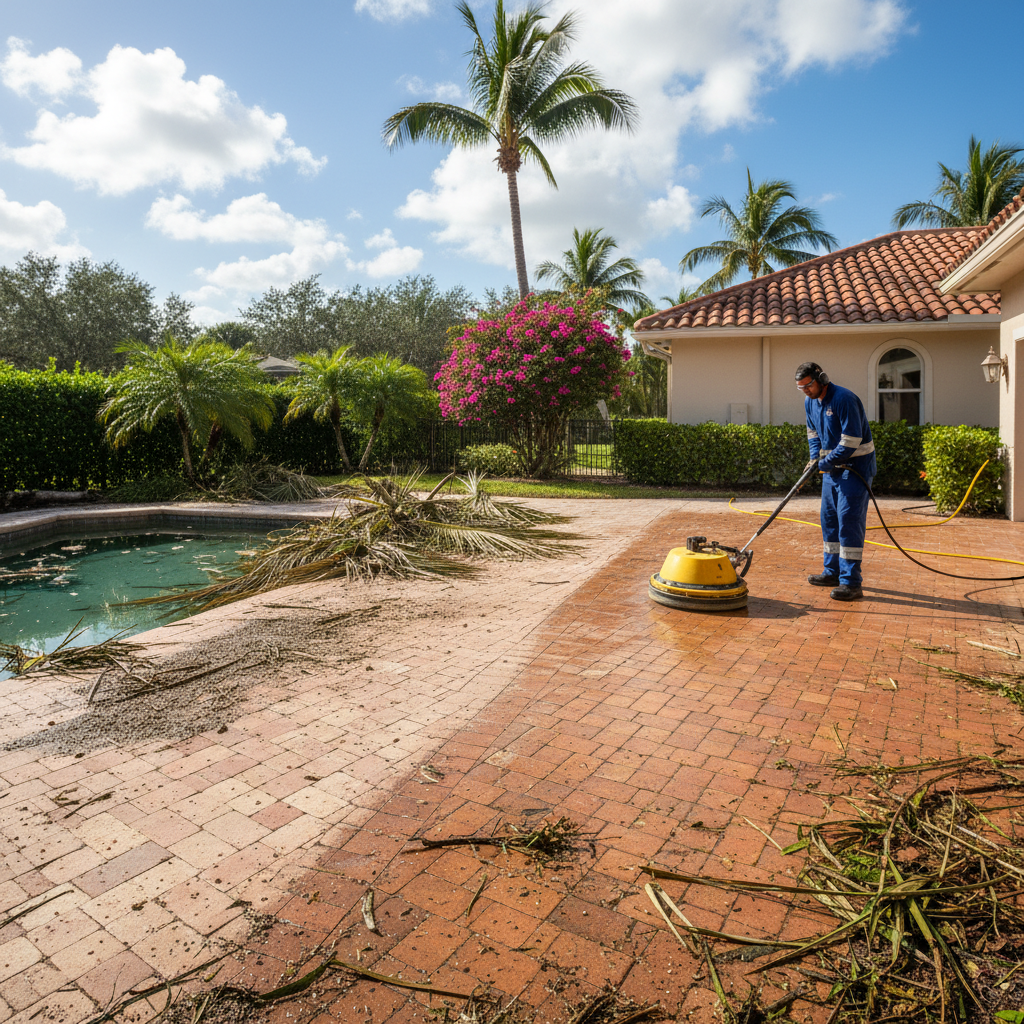
- Clear loose debris by hand: palm fronds, branches, leaf piles, broken outdoor furniture
- Schedule pressure washing for driveways, walkways, pool decks, and patios once debris is cleared
- Pressure wash roof and exterior walls to remove salt residue and storm-deposited organic matter before biological growth establishes
- Address any specific stains: oil from generators, leaf tannin runoff, paint scrapes from blown debris
- Re-sand paver joints and apply or refresh sealer once surfaces have fully dried
Coastal properties near Biscayne Bay, the Atlantic, or the Intracoastal Waterway should prioritize salt removal. Storm surge and wind-driven salt mist deposit corrosive material on stucco, aluminum window frames, and painted surfaces. Letting salt sit for weeks accelerates oxidation and paint failure.
For larger storm aftermath jobs, our commercial pressure washing program handles HOA common areas, office complexes, and multi-building properties on accelerated post-storm timelines.
Photo Documentation for Insurance
Ready.gov's federal post-storm guidance explicitly tells homeowners to document any property damage with photographs and contact the insurance company for assistance. This single step is the most often skipped one and creates the most disputes later.
The Best Practice Pattern
The pre-and-post photo pair is what insurance adjusters reward. Walk the property in the days leading up to the storm and take time-stamped photos of every roof slope, every exterior wall, the driveway, pool deck, fence line, and any landscaping that could be a damage indicator. After the storm, repeat the walk from the same vantage points before any cleanup begins. The contrast becomes the documentary record.
Pressure washing crews can help here too. A reputable contractor will take their own before-and-after photos during a storm cleanup and provide copies. Those make useful supplements to a homeowner's own documentation when storm-cleanup costs become part of an insurance claim.
Mold After the Storm
Mold becomes a serious concern within 24 to 48 hours of moisture intrusion. Ready.gov's federal cleanup guidance specifically calls out mold as a hazard that requires protective clothing and appropriate face coverings or masks during cleanup. Ready.gov adds that people with asthma and other lung conditions, or with immune suppression, should not enter buildings with indoor water leaks or visible or smellable mold growth, even if those individuals are not allergic to mold themselves.
Where Mold Shows Up Fastest in South Florida
Exterior mold appears first on north-facing walls, under eaves and soffits, on shaded driveways and pool decks, and on any porous surface that stays damp for days after a storm. Soft washing with a sodium hypochlorite solution and surfactant is the standard treatment for early-stage exterior mold on stucco, siding, brick, and concrete. The chemistry kills the colony at the spore level rather than just rinsing surface discoloration away.
Interior mold from water intrusion is a different problem and is outside the scope of a pressure washing contractor. The CDC publishes a guide to mold cleanup that Ready.gov links to for indoor work, which often requires a remediation specialist rather than an exterior cleaning crew.
HOA and Commercial Scheduling Notes
Property managers and HOA boards work on different timelines than individual homeowners. A few practical notes drawn from the Florida Homeowners' Association Act (Chapter 720) and what most South Florida community associations actually do:
- Pre-season wash typically scheduled in May and approved at the April board meeting
- Post-storm emergency cleanup contracts fall under the Florida Statute 720.3055 emergency exception to competitive bidding, but the emergency basis should be documented in the next board minutes
- Annual contracts that include post-storm response clauses are easier to execute on tight timelines than ad-hoc bids after a named storm
- Document every vendor's certificate of insurance and workers compensation status before storm season so emergency vendor onboarding is not a scramble
For more on what Florida law requires when boards approve pressure washing contracts, see our Florida HOA pressure washing requirements guide. For broader hurricane-season property care beyond pressure washing, see our companion piece on hurricane season property care for South Florida.
Frequently Asked Questions
When does Atlantic hurricane season officially start?
The Atlantic hurricane season runs from June 1 to November 30 according to the National Hurricane Center. The peak of the season is September 10, with most activity occurring between mid-August and mid-October. Based on the 1991-2020 climate period, an average Atlantic season produces 14 named storms, 7 hurricanes, and 3 major hurricanes. NOAA typically releases its initial seasonal outlook in late May, just before the season opens.
What is the best month to pressure wash a South Florida home before hurricane season?
Late April through mid-May is the best window. Surfaces have dried out from the winter dry season, the spring pollen peak is passing, and there is enough time before June 1 for any optional sealer to fully cure. April-May scheduling also matches Ready.gov's federal pre-season checklist, which calls out decluttering drains and gutters as a pre-storm action. June and July still work for catch-up jobs, though scheduled work is more vulnerable to rain interruption and could be undone by the first named storm.
Should I pressure wash during peak hurricane season (August to October)?
Major projects are better deferred. NHC climatology shows most Atlantic hurricane activity occurs between mid-August and mid-October, with the absolute peak on September 10. Newly washed surfaces, applied sealer, and re-sanded paver joints are all vulnerable to storm rain and wind during this window. Light maintenance washing (sidewalks, mailbox kiosks, tactical spot cleaning) is still reasonable. Full-property packages and paver sealing make more sense in May before the season or in late November after it ends.
How soon after a hurricane can I pressure wash?
Wait for utility and structural safety clearance, document storm damage with photographs as Ready.gov recommends, and clear loose debris by hand first. Most South Florida properties are ready for pressure washing 48 to 72 hours after the storm passes, assuming power and water service have returned. Roof and exterior wall washing to remove salt residue and storm-deposited organic matter is most effective within the first week, before biological growth establishes a foothold on damp surfaces. Coastal properties within a mile of the Atlantic or Biscayne Bay should prioritize salt removal sooner because salt is corrosive to stucco, aluminum frames, and painted surfaces.
Will pressure washing wash water cause an environmental violation during storm season?
It can, particularly during heavy storm rain. Wash water containing detergents, surfactants, or biological cleaners is classified as an illicit discharge under the federal Clean Water Act when it enters a storm drain. The Florida Department of Environmental Protection administers the NPDES stormwater permitting program under Section 403.0885 of the Florida Statutes. FDEP's mobile washing best management practices identify four lawful disposal options: zero-discharge closed-loop recycling, discharge to municipal sanitary sewer with utility approval, discharge to land or ground (which may require FDEP authorization), and discharge to surface water (which requires an NPDES permit and is typically not practical). Reputable South Florida pressure washing contractors capture or divert wash water rather than letting it run into storm drains.
Should I take photos of my property before a storm?
Yes. Ready.gov's federal hurricane guidance explicitly tells homeowners to document any property damage with photographs and contact the insurance company for assistance. The most useful documentation is a pre-and-post pair: time-stamped photos of every roof slope, exterior wall, driveway, pool deck, and fence line taken in the days before a storm, then the same vantage points captured before any cleanup begins. The contrast becomes the documentary record an insurance adjuster looks for. Reputable pressure washing contractors also take their own before-and-after photos during storm cleanup and provide copies on request.
Sources Referenced
- • National Hurricane Center, Tropical Cyclone Climatology (nhc.noaa.gov/climo) - Atlantic hurricane season dates, 1991-2020 climate averages of 14 named storms / 7 hurricanes / 3 major hurricanes, peak date of September 10, progression tables of average formation dates
- • NOAA Climate Prediction Center, Atlantic Hurricane Outlook (cpc.ncep.noaa.gov) - Updated 2025 Atlantic Hurricane Season Outlook issued August 7, 2025
- • NOAA News Release, 2025 Atlantic Hurricane Season Outlook (noaa.gov, May 22, 2025) - Initial 2025 outlook probability ranges (60/30/10 above/near/below normal; 13-19 named storms, 6-10 hurricanes, 3-5 major hurricanes; 70% confidence)
- • Ready.gov Hurricanes (ready.gov/hurricanes) - Pre-storm preparation actions including decluttering drains and gutters, post-storm documentation with photographs, mold safety guidance including protective clothing and masks, and asthma/lung condition warnings about mold-affected buildings
- • Florida Department of Environmental Protection NPDES Stormwater Program (floridadep.gov/water/stormwater) and Section 403.0885 of the Florida Statutes - State authority to administer the NPDES stormwater program in Florida since October 2000
- • FDEP Recommended Best Management Practices for Mobile Vehicle and Equipment Washing - Four wastewater disposal options applicable to pressure washing
- • Florida Statute Chapter 720 and Section 720.3055 - HOA emergency-purchase exception to competitive bidding requirements
This guide is for general orientation only. Hurricane forecasts change, NOAA updates its seasonal outlooks throughout the year, and storm impacts vary by property and location. Consult your insurance carrier and licensed contractors for decisions tied to a specific storm event.
Related Articles
Hurricane Season Property Care: South Florida's Complete Storm Protection Guide
Broader property protection beyond pressure washing, from shutters to landscaping to post-storm recovery.
Best Times to Pressure Wash Your Property in South Florida
How the South Florida climate calendar drives optimal pressure washing timing across the full year.