Soft Wash vs Pressure Wash: South Florida Guide
Soft washing and pressure washing are different technologies with different jobs. Confusing them is the single most expensive mistake South Florida homeowners make with their exterior maintenance. This guide separates them cleanly and shows which fits each surface in the South Florida climate.
Sourcing. Technique authority references the Asphalt Roofing Manufacturers Association (ARMA) technical bulletins and GAF Technical Advisory Bulletin TAB-R-102. Chemistry references the ARMA-approved 50:50 bleach-water recipe and GAF's 4:1:1 water:bleach:TSP recipe. Sources are cited in full at the bottom of the article.
Quick Navigation
The 30-Second Answer
- • Soft washing uses chemistry (bleach or sodium hypochlorite plus surfactant) at low pressure (typically under 500 PSI) to kill biological growth at the spore level. Best for roofs, painted stucco, siding, screen enclosures, and any surface that would be damaged by high pressure.
- • Pressure washing uses mechanical force (typically 2,000 to 4,000 PSI at the nozzle) to physically blast dirt, grime, and staining off durable surfaces. Best for concrete driveways, paver walkways, pool decks, and other hard surfaces that can take the force.
- • Asphalt shingle roofs must be soft washed. Both ARMA and GAF explicitly prohibit power washing shingles because it dislodges granules and causes premature roof failure.
- • Reputable contractors use both techniques as part of the same job, switching methods for different surfaces.
What Pressure Washing Actually Is
Pressure washing is a mechanical cleaning process. A pump pressurizes water and forces it through a specialized nozzle at pressures typically ranging from 1,500 PSI (consumer-grade) to 4,000 PSI (commercial-grade). The high-velocity water stream physically removes dirt, algae, moss, oil residue, and staining from durable surfaces.
The Equipment
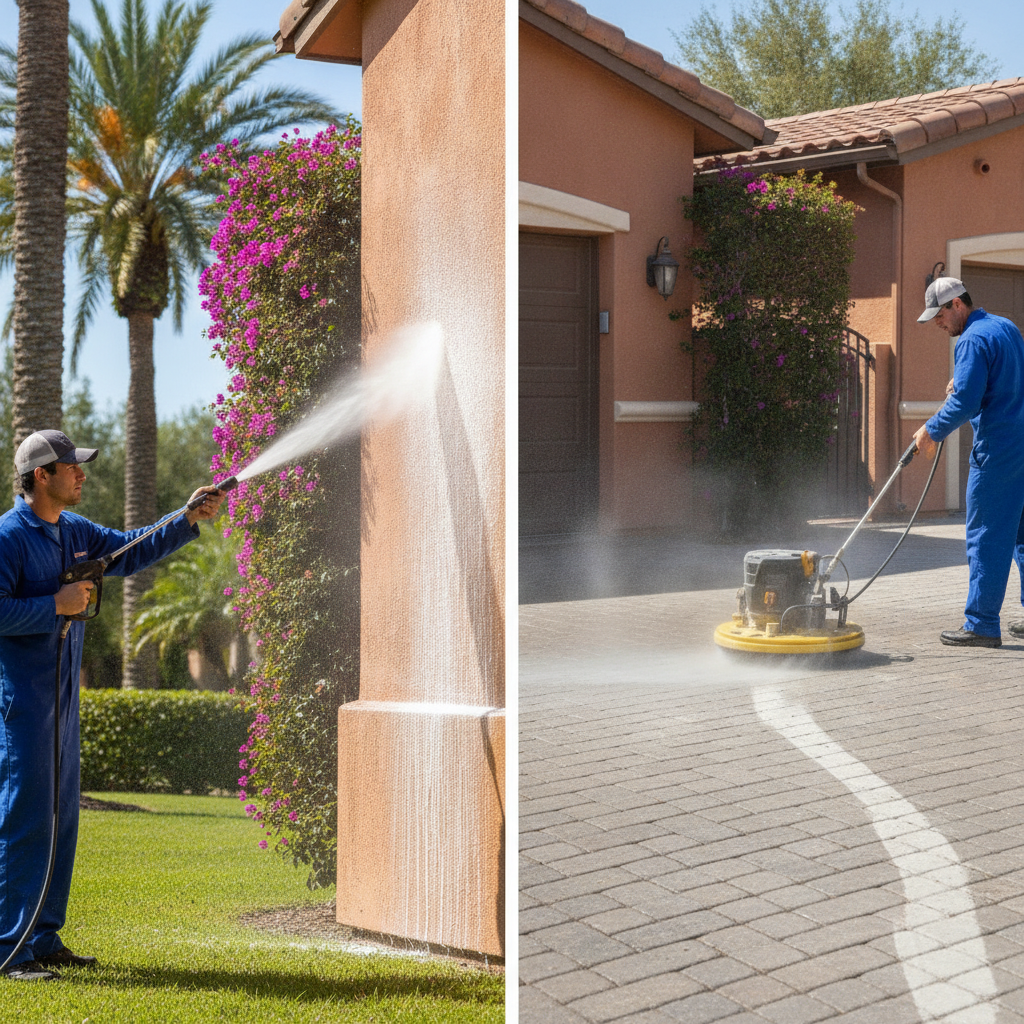
A professional pressure washing rig includes a gas or diesel pump, a high-pressure hose, a wand with a trigger, and a set of interchangeable nozzles or a surface cleaner attachment (the flat yellow disc you see on driveway jobs). Cold-water rigs handle most residential work. Hot-water rigs cost more but cut through grease and oil that cold water leaves behind.
What Pressure Washing Is Good For
- Concrete driveways and sidewalks
- Paver walkways, patios, and pool decks (with appropriate tip selection)
- Brick and unpainted stone walls
- Concrete parking decks and industrial floors
- Wood decks (with very careful pressure selection to avoid gouging)
- Fence lines: vinyl, aluminum, or well-sealed wood
- Trash enclosures and dumpster pads
What Soft Washing Actually Is
Soft washing is a chemistry-based cleaning process. A specialized low-pressure pump delivers a cleaning solution (typically sodium hypochlorite plus a surfactant) at pressures under 500 PSI, closer to garden hose flow. The chemistry does the cleaning work by killing biological growth at the spore level. The low-pressure rinse simply carries away the dead organism and cleaning solution.
The Equipment
A soft-wash rig looks similar to a pressure washing rig but the pressure is intentionally reduced and the chemistry system is more sophisticated. A dilution manifold blends bleach concentrate with water to a target percentage, and a downstream injector adds surfactant to help the solution cling to vertical surfaces.
What Soft Washing Is Good For
- Asphalt shingle roofs - this is not optional; ARMA and GAF both prohibit power washing shingles
- Painted stucco and siding on residential homes
- Coral stone, travertine, and other porous natural stone surfaces
- Painted or vinyl fencing
- Pool deck coping and tile
- Screen enclosures and pool cages
- Fabric awnings and canopies
- Composite decking (Trex, TimberTech, etc.)
Which Technique for Which Surface
Here is the quick-reference decision matrix for common South Florida surfaces.
| Surface | Technique | Why |
|---|---|---|
| Asphalt shingle roof | Soft wash ONLY | ARMA and GAF prohibit power washing; granule loss |
| Tile roof (concrete or clay) | Soft wash preferred | Chipping and cracking risk with high pressure |
| Metal roof | Soft wash | Paint coating and seam damage risk |
| Painted stucco walls | Soft wash | Paint stripping and stucco erosion |
| Vinyl siding | Soft wash | Water infiltration behind siding at high pressure |
| Concrete driveway | Pressure wash (surface cleaner) | Durable surface; needs mechanical action |
| Paver driveway | Pressure wash (soft touch) | 3,000 PSI max via surface cleaner; not direct nozzle |
| Coral stone / travertine | Soft wash only | Under 500 PSI; pH-neutral chemistry to prevent pitting |
| Pool deck (stamped concrete) | Pressure wash (surface cleaner) | Similar to driveway; watch for sealer damage |
| Pool cage / screen enclosure | Soft wash | Screen mesh damage at high pressure |
| Brick wall (unpainted) | Either (soft wash preferred) | Mortar erosion at high pressure; soft wash is safer |
| Wood deck / fence | Careful low-pressure or soft wash | Gouging and grain damage above 1,500 PSI |
A typical South Florida property therefore uses both techniques in a single visit: soft wash for the roof and painted exteriors, pressure wash for the driveway and hard-surface walkways. Trying to use one technique for everything is where damage happens.
Not Sure Which Surface Gets Which Technique?
We do soft wash and pressure wash on the same job when the property calls for it, and we specify exactly which technique goes on which surface in every quote. Serving Miami-Dade, Broward, and Palm Beach.
The Chemistry Behind Soft Washing
The active ingredient in almost all professional soft washing is sodium hypochlorite, the same chemical as laundry bleach but often at higher concentration. Household bleach is roughly 5 to 6 percent sodium hypochlorite. Professional soft-wash concentrate is typically 10 to 12.5 percent and is diluted on-site to a target percentage depending on the job.
ARMA's Recipe for Roofs
For asphalt shingle roofs, ARMA's technical bulletin on algae discoloration specifies: "The most effective method of cleaning algae and moss from a roof is with a 50:50 mix of laundry strength liquid chlorine bleach and water. Apply with a sprayer and allow the solution to dwell on the roof surface for 15 to 20 minutes, and then rinse thoroughly with low pressure water."
GAF's Alternative Recipe
GAF Technical Advisory Bulletin TAB-R-102 specifies a slightly more dilute mix: "4 gallons of water, 1 gallon of bleach and 1 cup of TSP (Tri-Sodium Phosphate or acceptable phosphate-free substitute). Apply this mixture with a garden sprayer, let sit on the roof surface for up to 20 minutes, and rinse with low-pressure water."
Surfactant Role
Professional soft washing adds a surfactant (typically a mild detergent) to the bleach solution. The surfactant reduces water surface tension, letting the solution cling to vertical walls and dwell long enough to kill algae rather than sheeting off immediately. Without a surfactant, most of the bleach runs off before it has time to work.
Landscape Protection Is Not Optional
Sodium hypochlorite kills plants. Pre-wetting all landscaping around the work area is not optional; it prevents leaf burn and root damage. During the wash, crews continuously rinse landscaping with fresh water to dilute any drift. Coastal South Florida bougainvillea, ixora, and hibiscus are particularly sensitive.
PSI Ranges: What the Numbers Mean
Pounds per square inch (PSI) is the pressure at the pump outlet, not what actually hits your surface. What matters more is the tip selection, distance from surface, and technique.
Common PSI Ranges
- • Soft wash system: 60 to 500 PSI (chemistry does the cleaning)
- • Wood deck cleaning: 500 to 1,500 PSI with a 40-degree fan tip
- • Vinyl siding via surface cleaner: 1,500 to 2,000 PSI
- • Concrete driveway via surface cleaner: 2,500 to 3,500 PSI
- • Paver driveway via surface cleaner: up to 3,000 PSI
- • Heavy commercial concrete via direct wand: up to 4,000 PSI
- • Coral stone / travertine: never above 500 PSI
The single biggest DIY damage pattern in South Florida is homeowners holding a 3,000 PSI direct nozzle six inches from a paver surface and cutting grooves into the stone. The tip matters more than the machine.
Cost Differences
Soft washing and pressure washing price similarly on a per-square-foot basis, but the total job cost varies with the mix of surfaces.
Typical 2026 South Florida Rates
- Soft wash residential roof: $0.20 to $0.35 per sq ft
- Soft wash painted stucco house exterior: $0.15 to $0.30 per sq ft
- Pressure wash concrete driveway with surface cleaner: $0.15 to $0.30 per sq ft
- Pressure wash paver driveway with surface cleaner: $0.30 to $0.50 per sq ft (includes re-sand)
- Soft wash pool cage / screen enclosure: $150 to $400 flat depending on size
- Full-property package (roof + exterior + driveway): $600 to $1,800 typical single-family
Bundled contracts save money because the crew is already on-site with equipment deployed. Booking a roof wash, house exterior wash, and driveway clean as a single visit typically runs 15 to 25 percent less than the same three services booked separately.
Where DIY Fits and Where It Fails
Both techniques have DIY versions, but the failure modes are different.
DIY Pressure Washing
A consumer-grade electric or gas pressure washer at 1,800 to 2,500 PSI works for small driveways, patios, and outdoor furniture. The DIY damage pattern is homeowners using the wrong tip and holding it too close, cutting stripes into pavers, gouging wood, or blowing paint off siding. Even homeowners who understand pressure washing routinely damage delicate surfaces because they use one tip for everything.
DIY Soft Washing
DIY soft washing with a pump sprayer and diluted household bleach works for small vertical surfaces like a shed exterior or a fence line. It fails on roofs because homeowners cannot safely apply the solution evenly across an entire roof plane, cannot control dwell time from a ladder, and cannot rinse landscape properly. Roof soft washing is one of the highest fall-risk DIY tasks in South Florida.
The Hidden DIY Cost
The bigger DIY problem is opportunity cost. A homeowner who spends a weekend on a driveway, pool deck, and house exterior is looking at 12 to 20 hours plus $150 in supplies. A professional crew does the same work in 2 to 4 hours for $400 to $800. Once you value your weekend time honestly, DIY only makes sense for very small jobs. Our companion post on 5 pressure washing mistakes that cost South Florida homeowners covers the specific DIY damage patterns.
Choosing the Right Contractor
The single biggest signal that separates a competent South Florida exterior cleaning contractor from an amateur is whether they specify which technique will be used on each surface in the written quote.
Ask These Questions
- "What technique will you use on my roof?" (Correct answer: soft wash, referencing ARMA or manufacturer guidance)
- "What PSI will you use on the driveway pavers?" (Correct answer: 3,000 max via surface cleaner, not direct nozzle)
- "What is your chemistry for the exterior stucco?" (Correct answer: sodium hypochlorite with surfactant, applied at low pressure)
- "How do you protect landscaping?" (Correct answer: pre-wet, tarp sensitive plants, continuous rinse)
- "How do you handle wash water?" (Correct answer: capture or divert per FDEP mobile washing best management practices)
- "Are you licensed and insured in Florida?" (Verify separately via county business tax receipt)
A quote that lists one flat price for "the whole property" without breaking out technique by surface almost always signals a contractor who uses one machine setting for everything. That is where paver damage, paint blowoff, and roof granule loss happen. See our companion piece on choosing a pressure washing company in South Florida for the full vetting checklist.
Frequently Asked Questions
What is the difference between soft washing and pressure washing?
Soft washing uses chemistry (sodium hypochlorite plus surfactant) at low pressure (under 500 PSI) to kill biological growth at the spore level. Pressure washing uses mechanical force (2,000 to 4,000 PSI) to physically blast dirt and staining off durable surfaces. Soft washing is for delicate surfaces (roofs, painted stucco, coral stone, siding, screen enclosures). Pressure washing is for durable surfaces (concrete driveways, paver walkways, pool decks, brick). Most professional South Florida jobs use both techniques in a single visit, switching methods for different surfaces.
Can I pressure wash my asphalt shingle roof?
No. Both the Asphalt Roofing Manufacturers Association (ARMA) and GAF explicitly prohibit power washing asphalt shingle roofs. ARMA states: "High-pressure washing systems are likely to damage asphalt roofing." GAF Technical Advisory Bulletin TAB-R-102 states that power washing "may dislodge granules, which can lead to premature shingle failure." The correct technique is soft washing with a bleach-based solution applied at low pressure via garden sprayer, dwelled for 15 to 20 minutes, then rinsed with low-pressure water. A contractor who offers to pressure wash a shingle roof does not know the trade.
What chemicals are used in soft washing?
Sodium hypochlorite (the active ingredient in bleach) is the primary cleaner. Household bleach is 5 to 6 percent sodium hypochlorite; professional soft-wash concentrate is typically 10 to 12.5 percent and is diluted on-site. ARMA specifies a 50:50 mix with water for asphalt shingle roofs. GAF specifies 4 gallons of water, 1 gallon of bleach, and 1 cup of TSP or a phosphate-free substitute. A surfactant is added to help the solution cling to vertical surfaces. Dwell time is 15 to 20 minutes before rinsing with low-pressure water.
What PSI should be used on a concrete driveway?
A commercial surface cleaner attachment operating at 2,500 to 3,500 PSI is the standard for concrete driveways in South Florida. The surface cleaner distributes the pressure across a 12 to 20 inch wide footprint, preventing the stripe patterns that direct nozzle work creates. Never hold a direct nozzle closer than 8 inches to the concrete surface at those pressures - it will etch stripes into the concrete. Paver driveways can take up to 3,000 PSI via surface cleaner but coral stone and travertine should never see anything above 500 PSI.
Does soft washing kill algae permanently?
Soft washing kills the current colony at the spore level, but ARMA notes the effect is "only temporary, and the discoloration may recur." In South Florida the year-round warm humid climate means visible regrowth typically appears within 18 to 36 months of a professional cleaning. Coastal properties see faster regrowth. Prevention measures like trimming tree canopy to expose the roof to direct sunlight, keeping gutters clean, and choosing algae-resistant shingles at reroof time extend the interval between cleanings. Zinc or copper strips work as inhibitors but ARMA notes they should only be installed at reroof, not retrofit.
Is soft washing more expensive than pressure washing?
Per square foot, soft washing and pressure washing price similarly in South Florida. Soft wash residential roof runs $0.20 to $0.35 per sq ft. Pressure wash concrete driveway with a surface cleaner runs $0.15 to $0.30 per sq ft. The bigger cost driver is total surface area and mix. A full-property package (roof soft wash, house exterior soft wash, driveway pressure wash) typically runs $600 to $1,800 for a single-family home in South Florida, with bundling saving 15 to 25 percent versus booking the three services as separate visits.
Sources Referenced
- • ARMA Technical Bulletin, "Algae Discoloration of Roofs" (asphaltroofing.org) - Prohibition on power washing asphalt shingle roofs, 50:50 bleach-water recipe, 15-20 minute dwell time, temporary nature of cleaning
- • ARMA Technical Bulletin, "Algae & Moss Prevention and Cleaning" - Surfactant and technique guidance, prevention measures, zinc/copper strip guidance
- • GAF Technical Advisory Bulletin TAB-R-102, "Blue-Green Algae Staining On Shingled Roof Surfaces" (documents.gaf.com) - 4:1:1 water:bleach:TSP recipe, power washing prohibition, granule loss and premature failure warnings
- • Dollar ranges throughout this guide are illustrative 2026 South Florida operational market observations. Specific pricing varies by scope, access, and property.
This guide is for general orientation only. Every property is different and pressure or technique selection ultimately depends on the specific surface, condition, and manufacturer warranty considerations. Consult a licensed South Florida contractor for property-specific decisions.